
By Christina Green | Chair-Elect, American Association of Interpreters and Translators in Education (AAITE)

The Language Access for All Act of 2026 is a proposed bill designed to codify, modernize, and permanently safeguard language accessibility requirements across all federal agencies and federally-conducted programs. Introduced first in the House (H.R. 7223) by Representatives Judy Chu, Grace Meng, Dan Goldman, and Juan Vargas in January 2026, and later in the Senate by Senators Andy Kim and Mazie Hirono, the bill is in direct response to the administrative rollbacks that revoked Executive Order 13166.
For a quarter century, Executive Order 13166 required federal agencies and recipients of federal funding to ensure meaningful access for individuals with limited English proficiency (LEP). Because executive directives can easily be repealed when an administration changes, the Language Access for All Act seeks to transform language access from a precarious administrative policy into an enduring statutory civil right.
The bill establishes a structured, accountable framework across the executive branch by:
-
Directing every federal agency to ensure individuals with LEP can meaningfully access all agency programs, services, and activities through qualified translation and interpreting.
-
Requiring each agency to appoint a dedicated Language Access Coordinator, maintain and regularly update comprehensive Language Access Plans with public notice and comment, and publish those plans on the LEP.gov website.
-
Creating a public complaint tracking system where LEP individuals and advocates can report barriers, denials, or failures in language services.
-
Setting technical standards for automated and digital communications, ensuring that AI tools are continually audited for bias and errors, comply with federal privacy rules, and never fully replace qualified human professionals.
About 25 million individuals in the United States are considered limited English proficient. For these communities, language barriers routinely block access to vital public infrastructure, including Medicare, Medicaid, disaster relief (FEMA), small business assistance, tax filings, and federal court proceedings.
The Act directly benefits the LEP population by:
-
Eliminating Service Disruptions: Establishing permanent statutory rights by preventing future administrations from discontinuing non-English documents, websites, and hotlines.
-
Ensuring Equal Due Process and Safety: Protecting LEP individuals against critical misunderstandings in high-stakes legal, medical, and financial environments.
-
Providing Direct Redress: Empowering communities by providing a mechanism for formal, tracked complaints in order to hold non-compliant agencies accountable.
-
Protecting Vulnerable Groups: Providing vital relief to linguistic minorities, including immigrant populations and Indigenous language speakers who have historically faced steep administrative barriers.
For professional language practitioners, the Act establishes essential professional standards and labor protections. The bill mandates the use of qualified, credentialed individuals, prohibiting agencies from relying on bilingual staff, minor children, or untrained family members to serve as ad-hoc interpreters and translators for essential public services.
A core element of the legislation explicitly bars federal entities from replacing qualified human linguists with unmonitored machine translation or artificial intelligence. All AI-assisted workflows must be validated, edited, and monitored by professional human translators and interpreters, preserving linguistic integrity and protecting working conditions.
By requiring agency-wide language access plans and permanent funding for multilingual services, the law ensures stable, long-term procurement demands for professional, credentialed language access services across the public sector.
The bill is currently in committee review in both chambers of Congress (the House Judiciary and Oversight Committees, and the Senate Committee on Homeland Security and Governmental Affairs). It has garnered extensive backing from civil rights coalitions, consumer advocacy organizations, and major language industry associations like the American Translators Association (ATA), the Association of Language Companies (ALC) and the National Asian Pacific American Bar Association (NAPABA).
As a standalone bill, the legislation faces significant political challenges in a sharply polarized Congress, making a straightforward floor vote uncertain. Historically, broad civil-rights codifications rarely move alone in divided legislative sessions; therefore, the most viable path toward passage is by attaching key provisions or language-access riders to broader must-pass federal funding packages (such as omnibus appropriations bills) or reauthorizations in late 2026. Advocates continue working to build bipartisan consensus around government efficiency, consumer fairness, and civil rights to advance its enactment.
The political outlook for the Language Access for All Act reflects both urgent grassroots momentum and steep institutional hurdles in a divided Congress. While the legislation enjoys unified support among civil rights organizations, immigrant advocacy coalitions, and professional translation and interpreting organizations, there is significant ideological resistance to federal language mandates and their associated administrative costs. The most effective approach, then, relies on the incremental, bipartisan packaging mentioned above, with congressional sponsors and policy advocates actively focused on taking the the bill’s core transparency, human-in-the-loop safeguards and its agency coordination requirements and attaching them to essential federal appropriations measures, judicial administration packages, or civil rights reauthorizations.
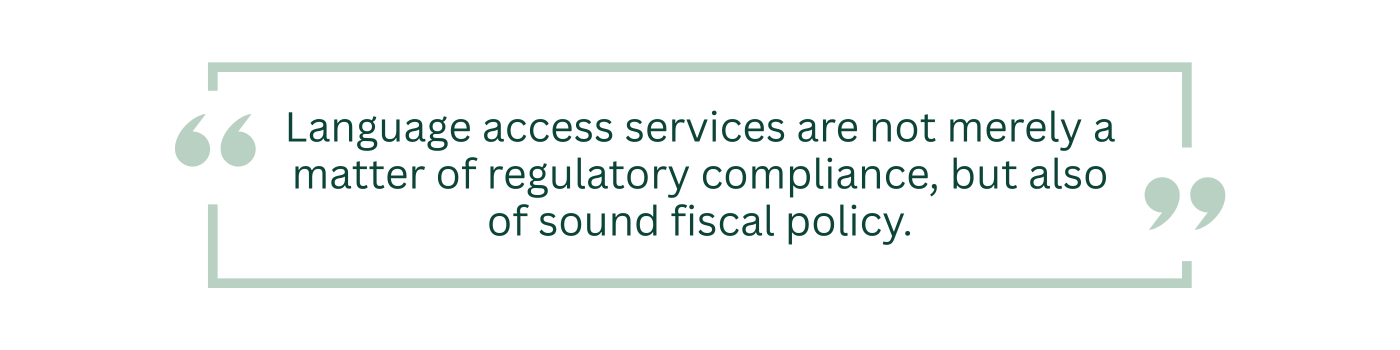
Language professionals hold essential frontline expertise that can directly shape congressional debate and advance the legislation by contacting their legislators and communicating ways in which costly administrative appeals, medical emergencies, and violations of due process occur when qualified human services are denied or replaced by unverified machine tools. They can also explain how language access services are not merely a matter of regulatory compliance, but also of sound fiscal policy that prevents administrative errors, speeds up federal casework, and preserves public safety.