
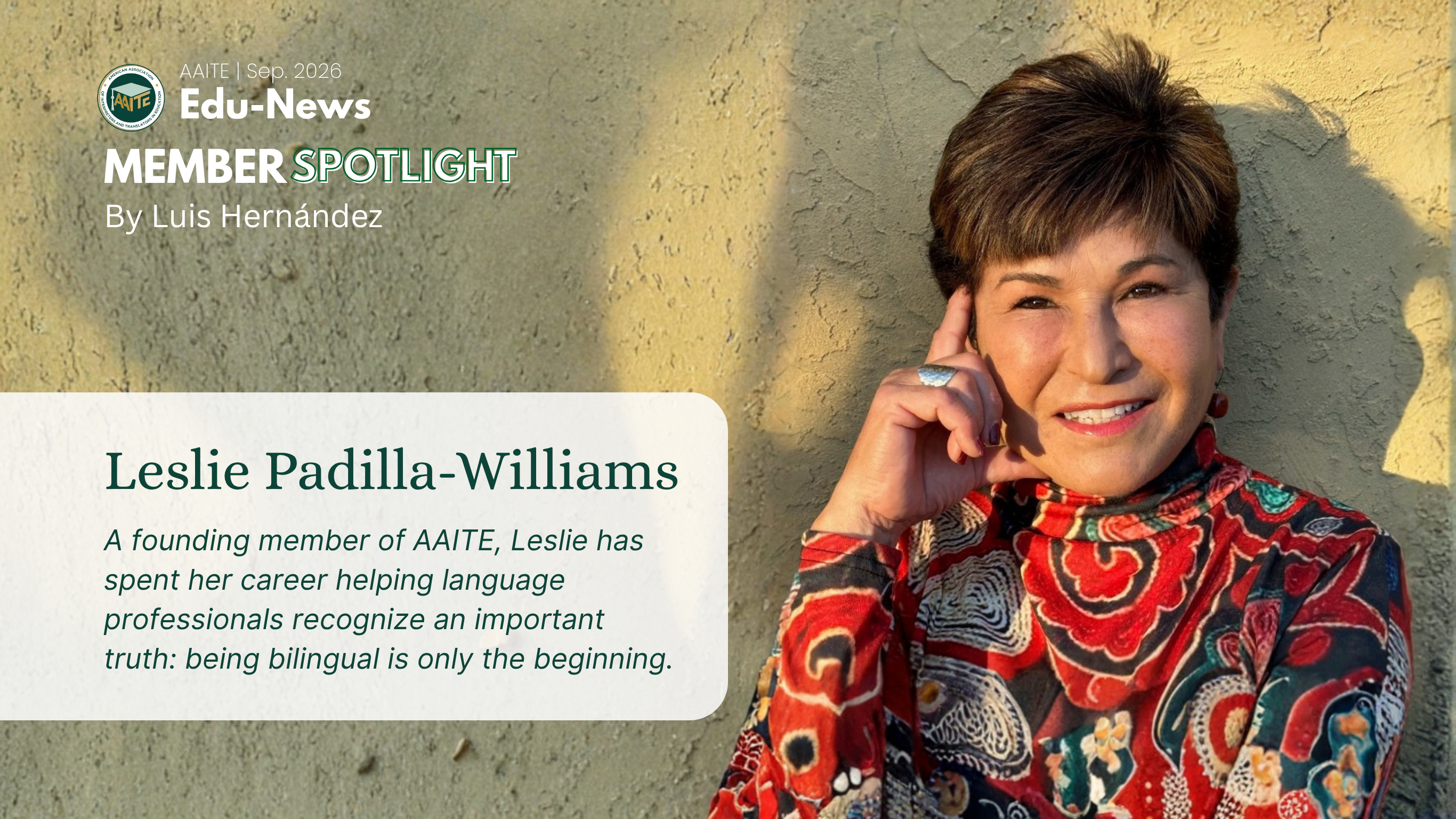
In this month’s Member Spotlight, we meet Leslie Padilla-Williams, a founding member of AAITE whose journey reflects the importance of specialized training, professional standards, and community. Leslie shares how an unexpected introduction to educational interpreting led to a career dedicated to preparing language professionals, advocating for meaningful language access, and helping others recognize that this work requires far more than simply being bilingual.
1. Tell us a little about yourself. What inspired you to become an interpreter or translator in educational settings, and what continues to motivate you today?
After completing law school in Guatemala City, my husband and I moved to Vista, California, so he could finish his career at Palomar College in San Marcos. Our plan was to eventually return to Guatemala, but in the meantime, I applied for a position as the district translator for Vista Unified School District.
Like many of my colleagues, I initially believed that being proficient in both English and Spanish was enough to translate and interpret in educational settings. Boy, was I wrong! The first time I interpreted an IEP meeting and heard phrases such as, “Your EL student will be placed in an SDC classroom and receive RSP pull-out services,” I knew I was in trouble.
I began taking translation and interpretation courses through UC San Diego Extension and the University of Georgia, as well as medical and legal interpreting courses. Along the way, I discovered that I truly loved this field. I also earned an Adult Education Multiple Subject Credential to deepen my understanding of the K–12 educational system and learn how to teach these skills to my colleagues.
What continues to motivate me is knowing that well-trained educational interpreters and translators can make a meaningful difference in the lives of students and families by helping ensure that language is not a barrier to meaningful participation.

2. Educational interpreting and translation can be incredibly rewarding and incredibly challenging. What is one challenge you've faced that other members would likely relate to?
Before I learned about ethics and standards of practice, I simply followed whatever administrators told me to do. That sometimes meant summarizing instead of interpreting everything that was said, sitting away from the parent rather than next to them, not asking for clarification when something was unclear, and even signing IEP documents that had not yet been completed.
I now realize that many educational interpreters have probably faced similar situations. One of our biggest challenges is that the role of the interpreter or translator is often misunderstood by the very people who rely on our services.
Another ongoing challenge has been educating educators and administrators about what meaningful, accurate, and culturally responsive translation and interpretation services for Limited English Proficient parents should look like.
3. How has AAITE supported you through those challenges? Share a specific experience, resource, training, or connection that made a meaningful difference.
A couple of years ago, I was hired by a school district to train its paraeducators to interpret IEP meetings. To my surprise—and chagrin—when the participants introduced themselves, I realized that the group included parents, cafeteria staff, and maintenance workers.
I spoke with the coordinator and explained that only appropriate and competent staff should be assigned to interpret important educational meetings. I even shared the California Department of Education’s guidance on the issue. Unfortunately, I quickly realized that my message was not getting through.
That is when I contacted AAITE. Giovanna Carrerio-Contreras helped me communicate with the coordinator and superintendent about why this group did not meet the definition of “appropriate and competent staff” referenced in my training proposal.
Hallelujah, I was not alone anymore! That experience reminded me of the tremendous value of belonging to a professional organization whose members understand the unique challenges we face in educational settings.
4. Looking back, what professional skill or mindset has grown the most since becoming involved with AAITE? Can you share an example?
I am very proud to be a founding member of AAITE and to have served as Chair of the Job Task Committee.
Perhaps the most important mindset shift I have experienced is realizing that educational interpreters and translators are not alone. We are part of a professional community with shared challenges, responsibilities, and goals.
I have also developed a stronger understanding that language access is not the responsibility of interpreters and translators alone. Administrators and educational institutions must also be accountable for ensuring meaningful language access by working collaboratively with qualified language professionals.
Finally, I have learned the importance of continuing professional development. Educational interpreting and translation require specialized knowledge, and ongoing, high-quality training is essential.
5. AAITE is built on community. Tell us about a member, mentor, or networking opportunity that positively influenced your career or reminded you that you weren't navigating this work alone.
The situation involving the school district that had assigned parents, cafeteria staff, and maintenance workers to interpret IEP meetings stands out.
Although I had the professional knowledge and resources to explain why this was inappropriate, I found myself struggling to get the district to understand the seriousness of the issue.
Reaching out to AAITE connected me with a colleague who understood the professional, ethical, and legal concerns involved. That support made a tremendous difference—not only in resolving the situation, but also in reminding me that I did not have to navigate these challenges alone.
For me, that is one of the greatest benefits of AAITE: knowing that there is a community of professionals who truly get it.
6. Advocating for language access and professional standards isn't always easy. Has AAITE helped you feel more prepared to advocate for yourself, your colleagues, or the students and families you serve? What did that look like?
Absolutely. For more than a decade, I relied on medical and legal interpreting and translation standards of practice because there were few resources specifically designed for educational settings. While those standards were helpful, they did not always apply 100% to the unique situations we encounter in schools.
I was over the moon when AAITE developed its Ethics and Standards of Practice for educational interpreters and translators. Having standards specifically designed for our profession has given me an invaluable resource to share with the interpreters I train and to help me navigate challenging situations.
AAITE has given me both the knowledge and the confidence to advocate for appropriate practices, professional boundaries, and meaningful language access for the students and families we serve.
7. Is there an AAITE event, webinar, conference session, publication, or resource that has changed the way you approach your work? What did you take away from it?
Without question, AAITE’s Ethics and Standards of Practice have had the greatest impact on the way I approach my work.
For many years, I relied on standards developed for medical and legal interpreters and translators. While valuable, they did not always address the unique circumstances and challenges of educational settings.
Having access to standards specifically developed for educational interpreters and translators has been a game changer. They have provided me with a framework for making professional decisions, navigating ethical dilemmas, and training others. Most importantly, they have helped validate what many of us have known for years: educational interpreting and translation are specialized professions that require specialized knowledge and skills.
8. Many educational interpreters and translators work in systems where their role isn't always fully understood or supported. How has belonging to AAITE helped you feel more connected, recognized, or empowered in your profession?
Being part of AAITE has helped me feel connected to a community of professionals who understand the unique challenges of educational interpreting and translation.
For many years, I often felt like I was trying to explain my profession to people who did not fully understand what interpreters and translators actually do—or what they should and should not be asked to do. Through AAITE, I have found colleagues, resources, and professional standards that reinforce the value and importance of our work.
Knowing that I can reach out to other professionals who understand these challenges has been incredibly empowering. AAITE has reminded me that we are part of a growing profession and that, together, we can advocate for stronger standards, better training, and meaningful language access for students and families.
9. When you think about the future of educational interpreting and translation, what gives you hope, and what role do you believe AAITE plays in moving the profession forward?
What gives me hope is seeing a growing recognition that educational interpreting and translation are specialized professions and that being bilingual alone is not enough.
AAITE is helping move the profession forward by spreading the word that the work of language access professionals is valuable, specialized, and deserving of ongoing professional development. AAITE is also creating the standards, training, resources, and professional community needed to strengthen our field.
I believe that as the profession continues to grow—and as AAITE certification becomes available—it will further legitimize educational interpreting and translation as a specialized profession. I also hope that this recognition will lead to greater respect for our work, stronger professional opportunities, and compensation that reflects the knowledge, skills, and responsibilities required.
10. Finish this sentence: “Being part of AAITE means…” Then tell us why those words matter to you.
Being part of AAITE means belonging to a group of language professionals who get it!
Those words matter to me because educational interpreters and translators often work in environments where our roles are misunderstood or we are expected to figure things out on our own. AAITE provides a professional home—a community of people who understand the challenges, celebrate the successes, and recognize the importance of what we do.
For me, being part of AAITE means knowing that I am not alone. It means having colleagues, resources, standards, and a shared commitment to advancing our profession.
AAITE’s Member Spotlight celebrates the individuals who make up our professional community. Each feature highlights a member’s experiences, contributions, and unique journey as an educational interpreter or translator.
Interested in sharing your story? Contact [email protected] to be featured in a future AAITE Member Spotlight.